|
Interpersonal Communication Workshops |
     
|
Interpersonal Communication Videos from Roger Reece
Here's a sampling of clips from recent training workshops with Roger Reece Seminars, dealing with interpersonal communication and communication-skills training. As these clips demonstrate, Roger is able to present the wide-range of complex concepts that form this discipline in a way that is practicable and immediately accessible to all class-members. More importantly, he emphasizes practice in the form of clearly-defined strategies and techniques to see improvement in communication impact and interpersonal outcomes right away.
We cover a wide variety of topics and skill-sets in the programs we offer; please visit our Youtube channel to find dozens more examples of the kinds of training we provide.

Proactive Communication
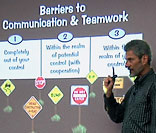
As we look at barriers to communication, what we're looking for is: what can you do? If an individual is not in the habit of sitting down and proactively working out communication issues directly, one-on-one, with sources of conflict, they can be a loss as to how to solve them - leaving them feeling frustrated and victimized. Good communicatators know that the best way to manage conflict is to deal with it directly.
Effective communication comes down to the individual: If you have a conflict with somebody, and they're being childish or doing all the wrong things, you can complain about them, or rationalize that you've done all you can do and the rest is up to them - but the fact is, you're being affected, and that makes you part of the problem. You've got to own the problem, if you want that problem solved.
Assertiveness vs Aggressiveness
When aggressive people don't get what they want, they soon begin to push. And whether they mean to do it or not, they tend to step on people's toes. Aggressive people are really good at being aggressive, because they've been practicing aggression all their lives. (They may even have become bullies.) Assertiveness, on the other hand, is closely tied to our definition of effective communication - which is that the effectiveness of your communication is measured by the response you get. Assertiveness is not about using force to get your way. Assertiveness is about being heard: having the courage and patience to convey your point of view in a way that the other person will understood.
The Negotiation Process: Goals, Roles & Procedures
Negotiation is a proven process for improving communication, building teamwork and resolving conflict. It is equally effective for the big problems that can cripple an organization, and all the little irritations that build up and cause friction between people who share an environment. The negotiation process is a conversation in three stages, where each stage is vital to building the foundation for the next, and the outcome is geared to win-win outcome for all parties involved. The process of "Goals, Roles & Procedures" identifies the sequence of steps and underscores the importance of firmly establishing each before effectively conducting the next. Speaker and coach Roger Reece outlines and describes the process in this clip from a 2011 workshop on Interpersonal Communication and Conflict Management. Roger pinpoints the common pitfalls that will undermine effective negotiation, and describes how to use Goals, Roles & Procedures to avoid them.
Communication, Ownership & Accountability
The difference between ownership and victimhood: As you move through your life, you stand somewhere on a continuum between victimhood and ownership. Each time you're faced with difficult situations, problems, or clashes with people, you have a choice: either to take ownership of the job of dealing with what is in front of you, or to fall to circumstances and accept defeat at the hands of forces beyond your control. And each decision you make moves you closer to one end of the continuum, and influences how you will choose in the future. There is undeniably a certain appeal to being the victim: it gives you the luxury of feeling like you are in the right, and you are at the mercy of unfair opposition; you have done all you can but the odds are insurmountable. Ownership, on the other hand, also implies ownership of defeat, if your efforts to solve the conflict are unsuccessful. You cannot cast off blame to another unreasonable person or an intractable system; you may have to own up to your mistakes, and make difficult choices or sacrifices to follow through on your commitments. But the practice of ownership, over time, increases your 'personal power' and expands your sphere of influence.
Communication: Reactions vs. Responses
Convert your negative reaction into a positive response: In the debrief following a manager-employee roleplay activity, speaker and coach Roger Reece stresses the broader importance of clarifying and being mindful of your goals before initiating a difficult conversation. What is the outcome that you want? How should you approach the person? Roger warns of the danger of falling into and acting upon an emotional reaction, creating and breeding dissonance, and describes how and why to convert that dissonant reaction into a resonant response. Roger also gives advice on what to do if you make a mistake and the conversation goes poorly.
Awareness, Creativity & Communication
Creativity's role in communication: Usually, we have very little trouble seeing what's wrong with what the people around us are doing. But it's next-to-impossible to accurately look at ourselves and say, "What's wrong with this picture?" None of us really see ourselves as well as other people see us - especially when we're stressed out. Inattentional blindness - an unconscious narrowing of our perception to only those objects and details that receive focused attention - affects everyone, and it only gets worse in moments of stress or irritation. One way to view creativity is the ability to find new ways of solving problems - to look at things from broader perspectives and see new possibilities. Creativity is what we need in order to communicate effectively, because we may need to try a variety of different approaches in order to connect with someone who can help us. Inattentional blindness is the enemy of creativity, and the greater the crisis or frustration we're under, the more we need to be wary of its effect: our "loss of vision" - a lack of creativity in moments of crisis - is often the very thing that sabotages our ability to resolve the conflict we're experiencing.
Negotiating Behavioral Change
Negotiation is the only way to bring about change - and negotiation is only effective to the degree that we're able to establish teamwork. When we try to negotiate at the moment we feel irritated, it's hard not to sabotage our own efforts. Sometimes it's really important to step back, consider our goals and approach, and gain the composure to honestly engage in the Goals, Roles & Procedures negotiation process. Negotiation is the only real way to bring about the kind of behavioral change that will allow two people or an organization or two organizations to work together effectively.
A solution begins with a complaint - but it's essential to shift to taking ownership of the situation, to actively committing to the challenge of solving the problem.
|
|
|
|